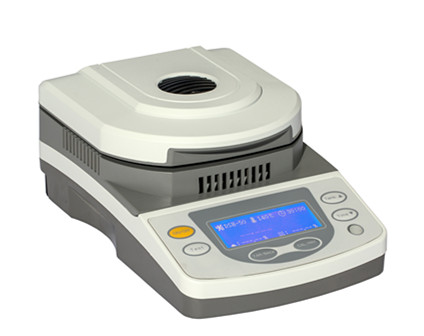
Food and beverage quality control is a repeatability problem before it is a sensitivity problem. Two laboratories with the same instrument get different results mainly because they grind, mix and subsample differently — so the first investment is a documented sample-preparation routine, not a better detector.
The five-measurement core covers a surprising share of declared specifications. Colour and absorbance handle appearance and many additives; moisture handles the most common compositional claim; sample mass underpins every calculation; pH or acidity covers preservation and taste; sodium and potassium cover the mineral declarations on most labels. A laboratory that can do these five reliably can usually add product-specific methods without another bench.
Where the specification talks about water content rather than loss on drying, or the product contains alcohol or volatile oils, the drying method will over-report. That is the point at which a Karl Fischer titrator earns its bench space — not as an upgrade, but as a different measurement.
How to plan the workflow
Food testing starts with the product specification and the way a sample moves through the bench. Record the sampling point, homogenization step, portion size and holding time before comparing instruments.
For an export project, describe the products, declared values, expected batch volume, local standards and report language. The configuration can then combine UV-Vis, moisture, weighing, titration and elemental measurements without leaving sample preparation as an afterthought.
Questions for a global project
- Does the method measure moisture, water content or total volatile loss?
- Which accessories and standards are needed for the product matrix?
- How will results be reviewed and exported between the plant and the central laboratory?