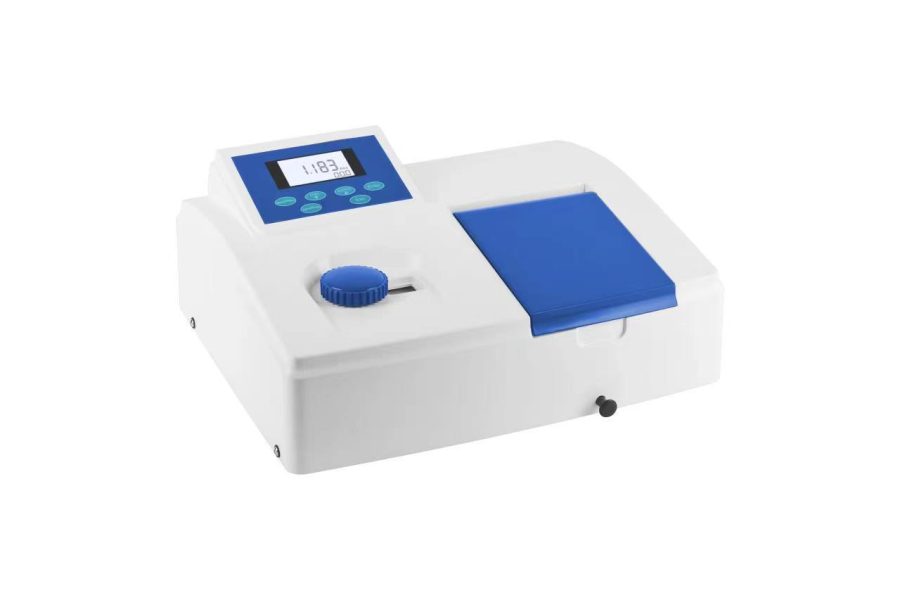
Primary configuration
1200 Series Basic Spectrophotometer
A basic single-beam instrument that covers the standard teaching experiments with simple controls.
Not intended for scanning methods or research-grade stability requirements.

Research
Instrument selection for teaching laboratories and research groups: absorbance, electrochemistry, weighing and microvolume work.
In short
Teaching laboratories need instruments that survive a class changeover and produce a result students can interpret: a basic single-beam spectrophotometer, a robust pH and conductivity meter, and a balance with enough capacity for preparation work. Research groups add scanning spectrophotometry, microvolume nucleic acid quantification, fluorescence and melting point determination.
The routine tasks behind a typical quality programme, the parameters involved and the instrument group that covers them.
| Measurement task | Parameters / range | Typical method | Instrument group |
|---|---|---|---|
| Teaching absorbance and calibration curves | 0–2 Abs · 340–1000 nm | Single-wavelength absorbance | Basic spectrophotometer |
| Spectral scans and method development | 190–1100 nm | Wavelength scan | Scanning spectrophotometer |
| pH, conductivity and ion measurement | pH 0–14 · 0–200 mS/cm | Direct immersion | pH / conductivity meters |
| Sample and reagent weighing | 0.001–0.1 g | Gravimetric | Electronic balance |
| Nucleic acid and protein quantification | 0.5–5000 ng/µL | Microvolume absorbance | Microvolume spectrophotometer |
| Fluorescence measurements | ng/mL to µg/mL | Fluorescence spectroscopy | Fluorescence spectrophotometer |
| Melting point in organic practicals | 0–400 °C | Capillary method | Melting point instrument |
| Water-chemistry practicals | mg/L range | Colorimetric or electrochemical | Spectrophotometer / meters |
Workflow
Most results are decided before the instrument is switched on. These are the steps where laboratories usually lose accuracy.
The practical schedule decides the wavelength range and the accessories.
Cuvette handling and cleaning between classes matter more than the optical specification.
Written steps reduce the questions that arrive during the practical.
Students need a file format they can open on their own laptops.
Covers, spare cells and a locked method set extend the life of a teaching instrument.
Start from a complete configuration rather than a single instrument: the supporting units decide whether the workflow runs without interruption.
Primary configuration
A basic single-beam instrument that covers the standard teaching experiments with simple controls.
Not intended for scanning methods or research-grade stability requirements.
Primary configuration
A robust electronic balance for reagent and sample preparation in a teaching laboratory.
0.1 g readability is not sufficient for analytical standard preparation.
Primary configuration
pH and conductivity in one meter for water-chemistry practicals.
Basic model; ion-selective work needs the P8 or P9.
Supporting
Microvolume quantification for nucleic acid and protein samples at very small volumes.
Not a general-purpose cuvette instrument; it complements rather than replaces one.
Supporting
Fluorescence measurements for research groups working at low concentration.
Requires method development and dark-room discipline to be useful.
Entry / alternative
The lowest-cost route to a fixed-wavelength teaching experiment.
Limited to the wavelengths the experiment needs.
Entry / alternative
Melting range determination for organic chemistry practicals.
One sample at a time; class throughput needs planning.
Method detail, common errors and configuration choices, written for this workflow.
Application note
How to choose instruments that survive a class timetable, produce interpretable results and can be shared with a…
Application note
A teaching laboratory guide to experiment design, sample handling and result export — aimed at an experiment a…
Application note
Why research teams should specify the accessory list, the operating environment and the data handover before ordering —…
A teaching laboratory buys for two users: the student who must understand the result, and the technician who must keep the instrument working across a timetable. Both are served by simple controls, a robust sample compartment and a protocol that does not depend on a specialist operator.
Research groups buy for a different reason: flexibility. Wavelength scanning, microvolume sampling and fluorescence open method space that a fixed-wavelength teaching instrument cannot reach. Sharing one scanning instrument between teaching and research is possible, but the changeover routine has to be written down, or the research group inherits the teaching laboratory’s cuvette wear.
Data export is the most commonly forgotten requirement. A student who cannot take the spectrum away in a usable format will photograph the screen, and the learning outcome is lost. Confirm the file format before the purchase, not after the first practical.
Teaching and research laboratories need instruments that are understandable to new users and flexible enough for the next experiment. Define the demonstrations, sample types, measurement range, throughput and data export before selecting the bench configuration.
An international education project also needs clear training materials, spare parts, language support and a practical service contact. A short method library helps students repeat the experiment while giving researchers room to develop a new method.
Short answers; send the details of your method for a definite reply.
One that covers the wavelengths of the practicals with a stable lamp and simple controls. Scanning and double-beam features add cost without changing the teaching outcome.
For coarse preparation, yes. Analytical work with reference standards needs 1 mg or 0.1 mg readability and a stable bench.
Only if the research group works with very small volumes, typically nucleic acid or protein quantification. It does not replace a cuvette spectrophotometer.
Plan by bench rather than student count. One meter per four to six students keeps the practical moving without queues.
Let’s talk about your application
Send your matrix, target parameters and reference method for a configuration review.