Yoke Application Team · Reviewed by Yoke Application Team · Updated October 22, 2026 · 3 min read
A volatile problem arrives as a complaint: the material smells wrong, the solvent is still present, the batch behaves differently in the press. The question behind the complaint is almost never “is there a volatile” — there usually is — but “which volatile, how much, and is the amount inside the specification”. That is a separation question, and separation is what gas chromatography does.
Four questions that point to GC
The decision does not depend on the catalogue. It depends on four answers.
- Is the compound volatile enough to enter the gas phase at a workable temperature? If it decomposes before it evaporates, gas chromatography is the wrong technique.
- Does the answer need identification, or only a total? A total solvent figure can come from loss on drying; identifying individual species needs separation.
- What concentration matters? Trace levels need a concentration step and a sensitive detector; percent levels do not.
- Is the matrix compatible with the inlet? Solids and high-boiling residues need headspace or extraction rather than direct injection.
What GC cannot tell you
Gas chromatography separates what evaporates. It says nothing useful about the non-volatile fraction, the polymer, the filler or the salt. A laboratory that buys a gas chromatograph to explain a whole formulation will be disappointed, and the disappointment is usually reported as an instrument problem.
The configuration follows the answer
| Question |
Configuration choice |
Reason |
| Which compounds, at percent level |
Wide-bore column, robust detector, simple inlet |
Resolution is not the constraint; repeatability is |
| Which compounds, at trace level |
Capillary column, sensitive detector, concentration step |
The sample must be concentrated before it is separated |
| Residual solvent in a solid |
Headspace sampling |
Avoids carrying the matrix into the inlet |
| Unknown mixture, method development |
Temperature programme with a wide range and several ramp steps |
The boiling range is not known in advance |
Sample preparation decides the result
For volatiles, preparation is the method. Headspace sampling measures the vapour in equilibrium with the sample, which is repeatable only if the equilibrium conditions are fixed: temperature, time and vial size. Direct injection measures what dissolves, which brings part of the matrix into the inlet. Solvent extraction measures what the solvent can reach. Each is valid, and each gives a different number for the same material.
When GC is the wrong purchase
Three signals: the question is a total rather than a species list, the sample load is a few per month, or there is no trained operator to own the method. In those cases a moisture analyser, a colorimeter or an outsourced analysis answers the real question at a fraction of the cost.
The brief
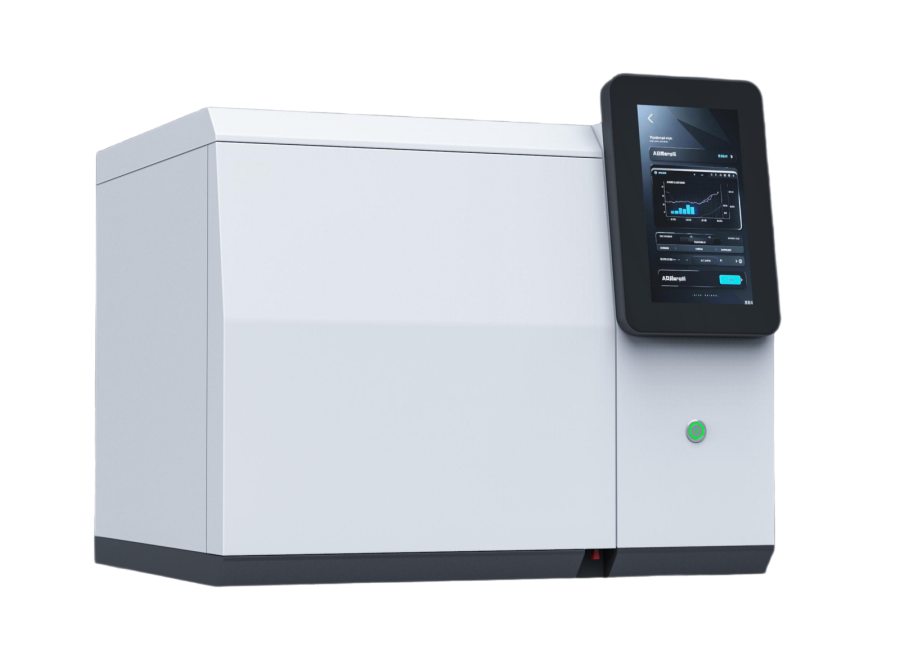
Send the compound list if it is known, the concentration range, the matrix form, the sample count per week, and whether the result has to be identified or only quantified. Add the gases available and the bench space. A gas chromatograph is a system, and the system is what gets installed.