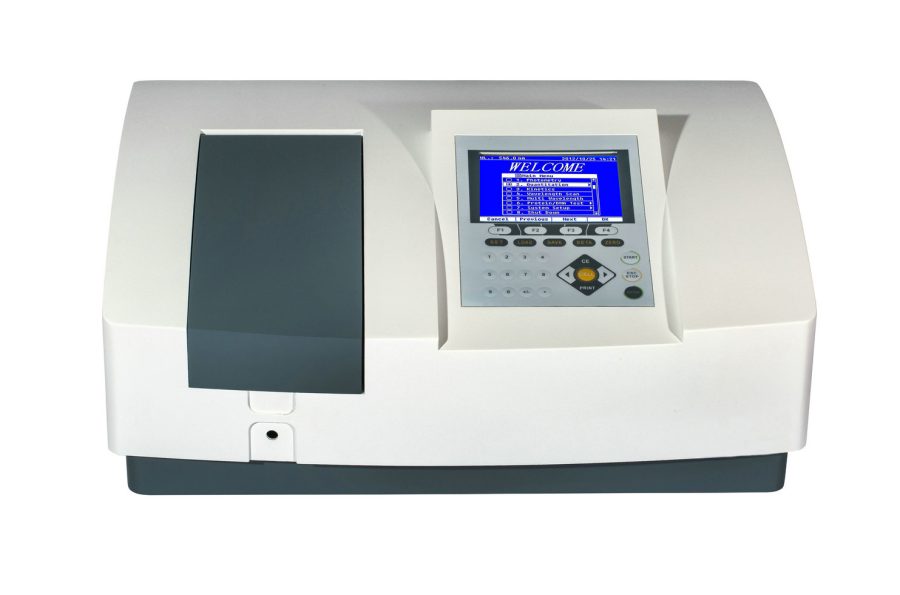
Primary configuration
1900 Series Double Beam Spectrophotometer
Double-beam optics with a reference channel: the stable baseline that long assay sequences need.
Single-beam instruments are cheaper but demand more frequent blanking.

Pharma
Instrument configuration for pharmaceutical quality control: assay by UV-Vis, water content, melting point, titration and weighing.
In short
Pharmaceutical QC is defined by documentation as much as by measurement. The core bench is a double-beam UV-Vis spectrophotometer for assay work, a 0.01 mg balance for reference standards, a moisture route (loss on drying or Karl Fischer), a melting point instrument and a titrator. Each purchase should be justified against the method it serves and the records it must produce.
The routine tasks behind a typical quality programme, the parameters involved and the instrument group that covers them.
| Measurement task | Parameters / range | Typical method | Instrument group |
|---|---|---|---|
| Assay by UV-Vis | 0.1–100 µg/mL | Absorbance at the method wavelength against a standard | Double-beam UV-Vis |
| Content uniformity checks | Absorbance or concentration | Same method, multiple units | Double-beam UV-Vis |
| Loss on drying | 0.1–100 % | Drying to constant mass | Moisture analyser |
| Water content | 0.01–5 % | Volumetric Karl Fischer titration | Karl Fischer titrator |
| Melting point / melting range | 0–400 °C | Capillary method with controlled heating | Melting point instrument |
| Assay and acidity by titration | 0.1–100 % | Potentiometric titration | Potentiometric titrator |
| Reference standard weighing | 0.01 mg | Gravimetric | 0.01 mg balance |
| pH of solutions and buffers | pH 0–14 | Direct measurement | pH meter |
Workflow
Most results are decided before the instrument is switched on. These are the steps where laboratories usually lose accuracy.
Wavelength, path length, standard concentration and acceptance criteria decide the configuration.
Installation, operation and performance checks belong in the record before the first sample.
The weighing step sets the uncertainty of the whole assay; the balance matters more than the detector.
Absorbance, dilution factors and the standard curve must be traceable in one place.
Access control, audit trail and export format are part of the instrument choice.
Start from a complete configuration rather than a single instrument: the supporting units decide whether the workflow runs without interruption.
Primary configuration
Double-beam optics with a reference channel: the stable baseline that long assay sequences need.
Single-beam instruments are cheaper but demand more frequent blanking.
Primary configuration
0.01 mg readability for reference standards and small weighed portions.
Needs a stable, draught-free bench to deliver that readability in practice.
Primary configuration
Water content where loss on drying would over-report the result.
Reagent handling and cell care are daily routines, not occasional ones.
Supporting
Melting range determination with a controlled heating ramp and a documented result.
Not a substitute for polymorph identification by spectroscopy.
Supporting
Assay and acidity by potentiometric titration with a stored method per product.
Colour-based endpoints are not equivalent for coloured solutions.
Supporting
pH of buffers and sample solutions with a replaceable electrode.
Not a compliance system on its own; calibration records must be kept separately.
Entry / alternative
Where the method weighs larger portions and 0.1 mg is sufficient.
Does not meet a 0.01 mg minimum sample weight requirement.
Method detail, common errors and configuration choices, written for this workflow.
Application note
The specification points that decide whether a UV-Vis spectrophotometer is fit for assay work, and the documentation that…
Application note
A documentation-focused checklist for connecting sample preparation, measurement, review and report export in pharmaceutical QC — where the…
Application note
The questions that separate two UV-Vis configurations for assay, identity and routine release work — wavelength, photometry, stray…
In pharmaceutical quality control the instrument is a small part of the purchase. The larger part is the evidence that the instrument is suitable, that it was suitable on the day of analysis, and that the records can be reconstructed years later. That is why the specification conversation should start with the method and the documentation package, not with the optical layout.
Two decisions shape the rest of the bench. The first is single beam versus double beam: double beam buys baseline stability and unattended sequence time, which matters when the assay method runs for hours. The second is the balance: 0.01 mg readability lowers the minimum sample weight, but it also raises the requirement on bench stability, draught control and calibration routine.
Moisture is the measurement most often configured by habit. Loss on drying is convenient and cheap per result; Karl Fischer measures water specifically. Where the specification states water content, or the matrix contains alcohol or volatile oils, drying will over-report and the method will not transfer between laboratories.
Pharmaceutical QC planning should connect the analytical method to the qualification and data record. Capture the wavelength or detector range, sample preparation, sequence length, acceptance criteria, calibration checks and user roles before requesting a final quotation.
The same brief should state the required certificates, installation scope, training, software records and service route. This prevents a technically suitable instrument from arriving without the documentation needed for transfer and routine use.
Short answers; send the details of your method for a definite reply.
Double beam when the method runs long sequences or demands a stable reference; single beam when measurements are short, frequent and re-blanked. The method and the validation plan decide.
Only if the specification asks for water content, or the matrix contains volatiles. They answer different questions and cannot be interchanged.
It reduces the minimum sample weight, which matters for reference standards and potent materials. It also demands a stable bench and a documented calibration routine.
For melting range as a pharmacopoeial test, yes. Identification by polymorph or spectral fingerprint needs a different technique.
The qualification package, calibration certificates and data export format. Ask for the exact list in writing, because it differs by product and software version.
Let’s talk about your application
Send your matrix, target parameters and reference method for a configuration review.